
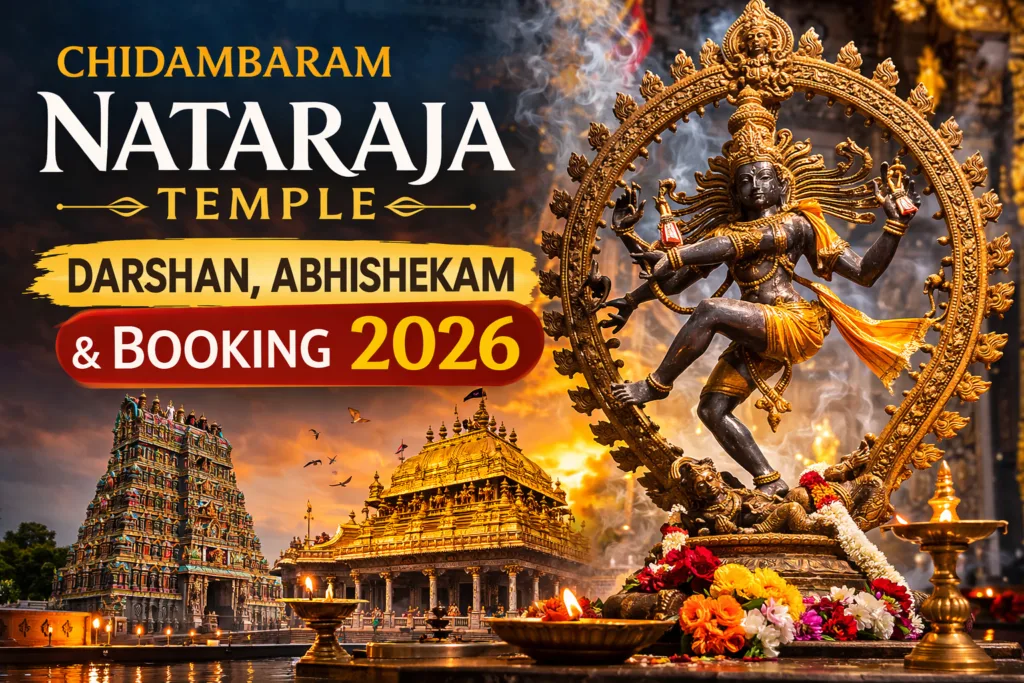
🕉️ Introduction: The Temple Where Space Itself Is God
Among the thousands of sacred temples scattered across Tamil Nadu, there is one that occupies a category entirely its own. It is not the largest — though it spreads across 50 acres. It is not the tallest — though its four Raja Gopurams tower magnificently over the surrounding plains. It is not even the oldest in Tamil Nadu — though it has roots going back to the Sangam period, more than two thousand years ago.
What makes Arulmigu Thillai Nataraja Temple at Chidambaram utterly unique — in all of India, in all of the world — is what lies at its very centre: nothing.
Behind the golden curtain in the innermost sanctum of this ancient temple, where the most sacred object of worship would normally stand, there is an empty space. A void. A darkness. And this emptiness is not an absence of God — it is God. The Chidambara Rahasya — the Secret of Chidambaram — is the revelation that pure consciousness, the formless Brahman, the infinite Akasha (ether), cannot be contained in any form. It can only be pointed to. Pointed to with golden bilva leaves hung in empty space, drawn aside by hereditary priests called Dikshitars, and glimpsed in a moment of grace that devotees travel thousands of miles to experience.
Chidambaram is one of the five holiest Shiva temples, each representing one of the five natural elements — Chidambaram represents Akasha (aether). The other four Pancha Bhuta Sthalams are Thiruvanaikaval Jambukeswara (water), Kanchi Ekambareswara (earth), Thiruvannamalai Arunachaleswarar (fire), and Sri Kalahasti (wind).
The temple houses one of the five fundamental Lingas in the Shaivite pilgrimage tradition and is considered the most subtle of all Shiva temples in Hinduism.
The name “Chidambaram” derives from “Chitrambalam,” often translated as “stage of consciousness” or “wisdom atmosphere,” reflecting its philosophical core.
This guide covers everything you need to plan a deeply informed pilgrimage to Chidambaram Nataraja Temple in 2026 — from exact daily pooja timings and the 6 annual Maha Abhishekam dates to the mystery of the Chidambara Rahasya, the Dikshitar tradition, festival schedules, booking details, and practical travel information.
ஓம் நமசிவாய | Om Namah Shivaya 🙏
🏛️ Temple Overview — Quick Reference
| Detail | Information |
|---|---|
| Full Name | Arulmigu Thillai Nataraja Temple (Thillai Nataraja Swamy Temple) |
| Main Deity | Lord Nataraja (Shiva as Cosmic Dancer — Ananda Tandava form) |
| Goddess | Sri Sivakamasundari (Parvati) |
| Also Called | Thillai Nataraja Temple; Chidambaram Kovil |
| Pancha Bhuta Element | Akasha (Ether / Space) |
| Pancha Sabha | Kanaka Sabha (Golden Hall) — one of 5 divine dance stages of Shiva |
| Temple Area | 50 acres |
| Administration | Hereditary Dikshitars (not HR&CE; uniquely self-managed) |
| Official Website | chidambaramnataraja.org |
| Entry Fee | FREE (General Darshan) |
| Morning Darshan | 6:00 AM – 12:00 Noon |
| Evening Darshan | 5:00 PM – 10:00 PM |
| Rudrabhishekam Cost | ₹72,000 (includes family attendance) |
| Online Booking | ❌ Not available — offline only at temple counter |
| Location | Chidambaram, Cuddalore District, Tamil Nadu — 608 001 |
| Distance from Chennai | ~235 km (4–4.5 hours) |
| Distance from Pondicherry | ~78 km (1.5 hours) |
| Nearest Railway Station | Chidambaram Railway Station (~2 km from temple) |
| Nearest Airport | Puducherry Airport (78 km) / Chennai (235 km) |
📜 History, Legend & The Dikshitar Tradition
The Cosmic Dance of Nataraja
A unique feature of this temple is the bejewelled image of Nataraja. It depicts Lord Shiva as the Lord of the dance Bharatanatyam and is one of the few temples where Shiva is represented by an anthropomorphic murthi rather than the classic, aniconic Lingam. The Cosmic Dance of Lord Nataraja symbolises the motion of the universe as sustained by Lord Shiva.
The Ananda Tandava — the “dance of bliss” — is Lord Shiva’s most profound creative act. His raised right foot symbolises liberation; his left foot, planted on the dwarf demon Apasmara (representing ignorance), symbolises the suppression of ego. The ring of fire surrounding him represents the cyclic nature of creation and dissolution. The drum in his upper right hand beats the rhythm of creation; the flame in his upper left hand signals dissolution. And his lower right hand gestures abhaya mudra — “fear not.”
In Chidambaram, this dance is believed to be eternally ongoing — not merely depicted, but actually occurring in the sacred space of the Chit Sabha.
The Dikshitars — Guardians of the Ancient Tradition
The temple has been traditionally administered by an endogamous group of Shaivite Brahmins called Dikshitars, who also officiate as its priests.
Unlike virtually every other major temple in Tamil Nadu — which is managed by the government’s HR&CE Department — Chidambaram Nataraja Temple is uniquely administered by the Dikshitars themselves, a hereditary community that has served this temple for centuries. Their right to administer the temple has been affirmed by the Indian Supreme Court.
Inscriptions and lore tie Chidambaram to Chola kings, including Raja Raja Chola I’s famed recovery of the Tevaram hymns preserved by the temple’s Dikshitars.
The Dikshitars are distinguished by their unique appearance — they wear their hair in a topknot on the right side of the head (unlike other Brahmin communities), wear sacred ash on their bodies, and are initiated through a rigorous traditional process that qualifies them to perform the temple’s ancient rituals. There are approximately 360 Dikshitar families — representing the 360 degrees of the cosmic circle — currently serving the temple.
The Three Forms of Shiva in Chidambaram
In Chidambaram, Lord Shiva is worshipped in three forms — the “full form” as the dancing Nataraja anthropomorphic murti; the “semi-form” as the Crystal Linga of Chandramouleswarar, the Spatika Lingam; and the “formless” as the Space in Chidambara Rahasyam, an empty space within the sanctum sanctorum.
This triple manifestation makes Chidambaram philosophically extraordinary — the only temple in India where the Saguna (with form), Sakala-Nishkala (semi-form), and Nirguna (formless) aspects of the divine are all present and worshipped within the same sanctum complex.
The Pancha Sabha — Five Divine Dance Stages
Chidambaram is one of the five places where Lord Shiva is said to have displayed his dance. Apart from Chidambaram, which has the Por Sabha (Kanaka Sabha — Golden Hall), the others are the Rathina Sabha at Thiruvaalangadu (ruby), the Chitra Sabha at Courtallam (pictures), the Rajatha Sabha (Silver Hall) at Madurai Meenakshi Amman Temple, and the Thaamira Sabha at Nellaiappar Temple, Tirunelveli.
🔮 Chidambara Rahasya — The Secret of Chidambaram
No other temple on earth has a mystery at its heart quite like the Chidambara Rahasya.
In the Chidambaram temple of Lord Nataraja, the Rahasya of Chidambaram is hidden by a curtain (Maya). The darshan of Chidambaram Rahasyam is possible only when priests open the curtain (or Maya) for special poojas.
The “secret of Chidambaram” is experienced when priests draw aside a curtain to reveal golden bilva leaves, signifying Shiva’s formless presence and inviting seekers to grasp the truth beyond maya. Philosophically, the Rahasyam points to the inner Self as Brahman — the unseen essence symbolized by space within the sanctum’s veiled emptiness.
When Is the Rahasya Revealed?
The Chidambara Rahasya curtain is opened during specific moments within the daily puja schedule. The darshan of Chidambaram Rahasyam during the 5th pooja (7 PM to 8 PM Irandaam Kaalam) includes the Chidambara Rahasya Pooja and Maha Aarthi.
The Rahasya is also revealed during special occasions including:
- The midnight Nishita Kaal Puja on Maha Shivratri
- The Arudra Darisanam grand darshan
- The 6 annual Maha Abhishekam days
- The Natyanjali Festival special performances
🌟 Pilgrim Tip: The evening 5th Kaalam (7:00–8:00 PM) is the most powerful time to witness the Chidambara Rahasya in a regular daily visit. Arrive by 6:45 PM and position yourself near the inner sanctum entrance.
⏰ Darshan Timings 2026 — Complete Daily Schedule
Morning: 6:00 AM to 12:00 noon. Evening: 5:00 PM to 10:00 PM.
The four outer gates of the temple are open from the time of the first ritual of the day till 13:00 hours (1 PM), and again from 16:00 hours (4 PM) till the conclusion of the evening procession. The outer doors of the Nataraja temple are closed between 12:00 and 16:00 hours. The doors to the innermost courtyard are closed between 12:00 and 16:45 hours.
| Session | Timings | Notes |
|---|---|---|
| Morning Darshan | 6:00 AM – 12:00 Noon | Outer gopurams open from first ritual; inner sanctum open from ~7:45 AM |
| Afternoon Closure | 12:00 PM – 4:45 PM | Outer gates closed 12–4 PM; inner sanctum closed 12–4:45 PM |
| Evening Darshan | 5:00 PM – 10:00 PM | All areas open from 5 PM |
| All Subsidiary Shrines | 7:30 AM–11:00 AM / 5:30 PM–8:00 PM | Including Govindaraja Perumal temple |
🕯️ The Six Daily Poojas — Complete Schedule with What Happens Inside
Each pooja includes Spatika Linga Abhishekam, Aarti, and Chidambara Rahasya rituals for Lord Nataraja.
Kaalam 0 — 6:30 AM | Paal Nivedhyam (Awakening Ceremony)
At 6:45 AM, Shiva, represented by his holy sandals (Padukai), is taken from the Bedchamber (Palliyarai) to the Chit Sabha by palanquin. This is called the Awakening ceremony.
What happens: The day begins not with a loud ceremony but with an act of intimate devotion — Lord’s sacred Paduka (footwear) is ceremonially carried from the Palliyarai (divine bedroom) to the sanctum in a palanquin. The Lord is “awakened” for the day’s worship. This quiet, tender moment before the day’s grand rituals is deeply moving for those present.
Kaalam 1 — 7:45 AM to 9:00 AM | Kalasandhi Pooja
7:45 AM to 9:00 AM: Kalasandhi Pooja (first pooja of the day) — during this time: Kalasandhi Homam, Spatika Linga Abhishekam, and Maha Aarthi are performed.
8:30–9:00 AM: A yagna or fire sacrifice is performed in the Kanaka Sabha, according to Vedic doctrine.
What happens: The first formal pooja of the day — the most comprehensive morning ritual. The Spatika Lingam (Crystal Shivalingam) receives its first sacred Abhishekam with milk, honey, curd, ghee, and sacred waters. A Vedic fire sacrifice (Homam) is performed in the sacred Kanaka Sabha (Golden Hall). The Maha Aarthi (grand wave of light) follows. This is among the best times to visit for darshan — the dawn light, the fragrance of fresh flowers, and the Vedic chanting create an atmosphere of extraordinary purity.
Kaalam 2 — 10:00 AM to 11:00 AM | Irandaam Kaalam (2nd Pooja)
10:00 AM to 11:00 AM: Irandaam Kaalam (2nd pooja of the day) — during this time: Spatika Linga Abhishekam and Rathna Sabhapathi (Ruby Nataraja) Abhishekam are performed.
What happens: The iconic Ruby Nataraja — the Ratnasabhapathi — is brought out for special Abhishekam. During Irandaam Kaalam (around 10:00 AM), Ratnasabhapathi (Ruby Nataraja) is brought out for special Abhishekam — one of the most beautiful moments inside the temple. The ruby-studded Nataraja idol glows under the lamplight as sacred waters and fragrances are poured over it — a sight of breathtaking beauty. The Spatika Lingam also receives its second Abhishekam.
Kaalam 3 — 11:30 AM to 12:00 Noon | Uchikaalam (3rd Pooja — Noon)
11:30 AM to 12:00 noon: Uchikaalam (3rd pooja of the day) — during this time: Spatika Linga Abhishekam, Aarthi, and then the Temple will be closed.
What happens: The final morning pooja — a concluding Abhishekam and Aarthi before the inner sanctum closes for the afternoon. Prasadam distribution follows. The gates close at 12:00 Noon for the sacred afternoon rest.
Kaalam 4 — 5:15 PM to 6:00 PM | Saayarakshai (4th Pooja — Evening)
5:15 PM to 6:00 PM: Saayarakshai (4th pooja of the day) — during this time: Spatika Linga Abhishekam and Shodasopachara Aarthi are performed.
What happens: The evening session opens with the Saayarakshai — a full 16-item (Shodasopachara) Aarthi, one of the most elaborate lamp-waving ceremonies of the day. The temple fills with the fragrance of camphor and incense as hundreds of lamps are waved before the deity. The Spatika Lingam receives its fourth Abhishekam.
Kaalam 5 — 7:00 PM to 8:00 PM | Irandaam Kaalam Evening (5th Pooja) ⭐ CHIDAMBARA RAHASYA
7:00 PM to 8:00 PM: Irandaam Kaalam (5th pooja of the day) — Spatika Linga Abhishekam, Chidambara Rahasya Pooja, and Maha Aarthi are performed.
What happens: This is the single most powerful pooja to witness during a regular visit to Chidambaram. The Spatika Lingam receives its fifth Abhishekam. Then, at the appointed moment, the Dikshitar priests approach the veiled inner sanctum of the Chidambara Rahasya and draw aside the golden curtain — revealing the empty space hung with golden bilva leaves. The Maha Aarthi that follows fills the entire sanctum with light, incense, and Vedic chanting.
🌟 Do not miss this pooja. Arrive by 6:45 PM. This is the moment that defines the Chidambaram experience.
Kaalam 6 — 9:00 PM to 10:00 PM | Ardhajaamam (6th & Last Pooja)
9:00 PM to 10:00 PM: Ardhajaamam (6th and last pooja of the day) — Spatika Linga Abhishekam, Maha Aarthi, and then Padhuka comes back to Palliyarai in a palanquin, Maha Aarthi at Palliyarai, Chandeswarar Aarthi, Bhairavar Aarthi, and Ardhajaama Sundharar Aarthi are performed.
What happens: The temple’s final pooja — a deeply intimate closing ritual mirroring the morning awakening. After the Spatika Lingam’s final Abhishekam and Maha Aarthi, the sacred Paduka is placed back in the palanquin and carried ceremonially to the Palliyarai — Lord’s “bedroom” — for the night’s rest. Special Aarthi is performed for Chandeswarar, Bhairavar, and Ardhajaama Sundharar before the temple closes.
Summary: Daily Pooja Schedule at a Glance
| Kaalam | Timing | Key Ritual |
|---|---|---|
| Paal Nivedhyam | 6:30 AM | Paduka brought to sanctum (Awakening) |
| Kalasandhi (1st) | 7:45–9:00 AM | Homam + Spatika Abhishekam + Maha Aarthi |
| Irandaam (2nd) | 10:00–11:00 AM | Ruby Nataraja Abhishekam + Spatika Abhishekam |
| Uchikaalam (3rd) | 11:30 AM–12:00 PM | Spatika Abhishekam + Aarthi (before closure) |
| Saayarakshai (4th) | 5:15–6:00 PM | Spatika Abhishekam + Shodasopachara Aarthi |
| Irandaam Evening (5th) | 7:00–8:00 PM | ⭐ Spatika Abhishekam + Chidambara Rahasya + Maha Aarthi |
| Ardhajaamam (6th) | 9:00–10:00 PM | Spatika Abhishekam + Maha Aarthi + Paduka returns |
🪔 Abhishekam at Chidambaram — Complete Guide
The Spatika Lingam Abhishekam (Daily)
The Spatika Lingam — the crystal Shivalingam worshipped by the sages Patanjali and Vyagrapada — receives Abhishekam during all six daily kaalams. Each daily Abhishekam is part of the standard temple ritual and can be witnessed by any devotee present during darshan hours.
The Six Annual Maha Abhishekam Days (2026)
Six Maha Abhishekams mark the annual calendar, including Margazhi Thiruvathirai (Arudra Darshan), Aani Thirumanjanam, and seasonal Chaturdashi observances, drawing vast congregations for Nataraja’s ceremonies.
The six annual Maha Abhishekam (Grand Abhishekam) dates for Lord Nataraja in 2026 are:
| # | Festival / Occasion | 2026 Date | Location in Temple |
|---|---|---|---|
| 1 | Chithirai Onam | April–May 2026 | Kanaka Sabha (Golden Hall) |
| 2 | Aani Thirumanjanam (Aani Uthira Darisanam) | June 22, 2026 (Monday) | Raja Sabha |
| 3 | Aavani Chaturdasi | August–September 2026 | Kanaka Sabha |
| 4 | Puratasi Chaturdasi | September–October 2026 | Kanaka Sabha |
| 5 | Aarudra Abhishekam (Arudra Darisanam) | January 3, 2026 (Saturday) | Raja Sabha |
| 6 | Maasi Chaturdashi | February 2026 | Kanaka Sabha |
Note: Aani Thirumanjanam in 2026 falls on Monday, June 22, 2026 — the most popular summer Abhishekam day, coinciding with the Aani Uthira Nakshatra.
The Rudrabhishekam — The Grand Private Abhishekam
The Abhishekam Seva costs ₹72,000 and includes personal/family attendance.
The Rudrabhishekam is the most comprehensive and spiritually powerful seva offered at Chidambaram — a full, elaborate Abhishekam ritual performed by the Dikshitars with the sponsoring family present inside the sanctum.
What is included in the ₹72,000 Rudrabhishekam:
- Full Mahanyasa Poorvaka Rudrabhishekam with sacred substances
- Family’s presence inside the sanctum during the ritual
- Vedic chanting of Sri Rudram, Chamakam, and Panchakshara
- Chandrmouleeshwara Spatika Linga Abhishekam
- Ratnasabhapathi (Ruby Nataraja) Abhishekam
- Prasadam and Theertham after the ritual
- Private darshan opportunity
Other Sevas & Archana at Chidambaram
| Seva / Archana | Approximate Cost | Notes |
|---|---|---|
| Ashtothara Archana (108 names) | Nominal | Daily; at temple counter |
| Sahasranama Archana (1,000 names) | ₹108–₹500 | Based on occasion |
| Panchakshara Trishati | Nominal | 300-name chanting |
| Ekasamaya Lakshaarchana | As announced | 1 lakh name chanting — special occasions |
| Mahanyasa Poorvaka Rudrabhishekam | Included in ₹72,000 | Full private ceremony |
| Maha Rudra Japa Yagna | As quoted | Contact Dikshitars directly |
| Moksha Deepam (for ancestors) | Nominal | Lamp lit for departed souls |
| Sahasra Bhojanam (1,000 persons fed) | As quoted | Annadanam for 1,000 devotees |
| Annapavaadai Mahaneivedhyam | As quoted | Grand food offering to deity |
💻 Booking Process — Darshan & Sevas (2026)
⚠️ Critical Note: No Online Booking System
Currently, no online booking system is available for Special Darshan. All bookings are offline and must be made at the temple ticket counter.
This is a crucial planning detail that most pilgrims are unaware of — unlike Tirupati, Sabarimala, or Arunachalam, Chidambaram Nataraja Temple has no online portal for darshan or seva booking. All bookings must be done in person.
How to Book Sevas at Chidambaram — Offline Process
Step 1 — Arrive at the Temple Booking Counter The temple administrative office and ticket/booking counter is located within the temple complex. Head to the main eastern entrance and ask a Dikshitar for directions to the Archanai counter.
Step 2 — Choose Your Seva At the counter, a list of available Archana and Seva options will be displayed. For major sevas like the Rudrabhishekam (₹72,000), advance contact with the Dikshitar community is strongly recommended — ideally weeks before your visit.
Step 3 — For Rudrabhishekam — Contact in Advance For the full family Abhishekam, contact the temple administration at chidambaramnataraja.org or through the Dikshitar association before your visit. Due to the limited slots and elaborate preparation required, walk-in Rudrabhishekam is rarely available.
Step 4 — Pay and Collect Receipt All payments at the counter are accepted in cash. Collect your receipt — this is your entry pass for the designated seva time.
Step 5 — Report 30 Minutes Before Seva Time Arrive at the designated seva entry point at least 30 minutes early. Dikshitars will guide you to the appropriate location within the temple complex.
💡 Planning Tip: Morning Kalasandhi (7:45 AM) or evening Sayarakshai (5:15 PM) are the best times for smoother darshan — these poojas draw slightly fewer crowds than the Ruby Nataraja Abhishekam at 10 AM or the Chidambara Rahasya pooja at 7 PM.
🎉 Major Festivals at Chidambaram Nataraja Temple 2026
⭐ 1. Arudra Darisanam 2026 — January 3, 2026
Chidambaram Temple celebrates Arudra Darshan, with the iconic Ananda Thandavam of Lord Nataraja on January 3.
Arudra Darisanam is the most sacred festival of the Chidambaram calendar — the day when the Thiruvathirai (Arudra) Nakshatra coincides with the full moon in the Tamil month of Margazhi. On this day, Lord Nataraja is believed to have performed the Ananda Tandava — his cosmic dance of bliss — in the Chit Sabha.
2026 Arudra Darisanam Schedule:
On January 3rd, at around 10 AM, Lord Natarajar will bless devotees with Sacred Jewels Thiruvabaranam Alankaram. Then Special Deeparadhanai and Rahasya Pujai will be done to Lord Nataraja. At around 12 PM noon, Pancha Murthi Thiru-veedhi-ula (street procession) will take place. Then at around 2 PM, Lord Nataraja and Goddess Sivakamasundari will proceed from Raja Sabha to Chit Sabha for the grand Gnanakasa Chit Sabha Pravesa Aakshi Arudra Darisanam.
10-Day Brahmotsavam (December 25, 2025 – January 4, 2026):
During the festival, for 9 days from December 25 to January 2, at Sayaratchai (evening), Sri Maanikavasagar Murti will be brought to Sri Natarajar Sannidhi, then Thiruvempavai will be sung and Vishesha 21 Deeparadhana will be held. During the Utsavam at morning, devotees can have darshan of the Thanga Velli Manjam Panchamurthi Veethi Ula procession.
Vahana (Vehicle) Procession Schedule — Arudra Darisanam 2026:
January 1, 2026 (Thursday) — Night: Bhikshadanar in Golden Chariot, followed by Sri Somaskandar in VettunGuthirai Veedhi Ula. January 2, 2026 (Friday) — Morning: Maha Rathotsavam (Therottam) — from 4:30 AM to 5:30 AM Lagna, Ratha Yatra Daanam. Night: around 7 PM — Special Laksharchana will be held at Raja Sabha.
| Date | Event |
|---|---|
| Dec 25, 2025 | Brahmotsavam begins |
| Dec 25 – Jan 2 | Daily Thiruvempavai chanting + 21 Deeparadhana every evening |
| Jan 1, 2026 | Bhikshadanar in Golden Chariot; Somaskandar Veethi Ula |
| Jan 2, 2026 | Maha Rathotsavam (Grand Chariot Festival) — 4:30 AM |
| Jan 3, 2026 | ⭐ ARUDRA DARISANAM — Ananda Tandava Darshan |
| Jan 4, 2026 | Brahmotsavam concludes |
Crowd Level: 🔴 Very High on January 3. Arrive by 8 AM for morning alankaram darshan.
⭐ 2. Maha Shivratri 2026 — February 15, 2026 (Sunday)
On Maha Shivaratri 2026, observed on Sunday, February 15, 2026, the temple hosts grand celebrations with special emphasis on Nataraja’s cosmic dance, elaborate Abhishekams, Vedic recitations, and night-long vigils.
The temple’s unique Chidambara Rahasya — an empty space behind a curtain in the sanctum representing pure consciousness — makes it profoundly mystical.
Maha Shivratri Programme:
- Suprabhata Seva + Maha Abhishekam — early morning with milk, honey, ghee, and Bilva leaves
- Four Prahar Pujas — night divided into four watches with dedicated rituals and Aartis
- Nishita Kaal Puja (Midnight Puja) — the most auspicious moment; Chidambara Rahasya curtain opened during midnight worship
- All-Night Jagran — mass chanting of Om Namah Shivaya, Shiva Tandava Stotram, Thiruvasagam
- Natyanjali Dance Performances — Bharatanatyam and classical dance offered to Nataraja
- The temple is also the venue for performing arts, including the annual Natyanjali Dance Festival on Maha Shivaratri.
Crowd Level: 🔴 Very High. Night darshan for the midnight Rahasya revelation is the defining experience.
⭐ 3. Natyanjali Dance Festival 2026 — ~February 17, 2026
Natyanjali Festival (around February 17, 2026) — dancers from across the world offer tribute.
The Natyanjali (“Anjali of Dance” — a dance offering to Nataraja) is one of the most distinctive and internationally celebrated events in India’s cultural calendar. Classical dancers from across India and the world — trained in Bharatanatyam, Kuchipudi, Odissi, Mohiniattam, and other traditions — gather at Chidambaram to offer their art as an act of worship to Lord Nataraja, the divine patron of all dance.
The eastern gopuram displays 108 Bharatanatyam karanas carved in stone — the same 108 karanas that form the foundation of Bharatanatyam technique, as documented in the Natya Shastra. Dancing at Chidambaram is not performance — it is a sacred offering where the dancer’s body becomes a vessel of divine expression.
The Natyanjali Festival runs across approximately 5 days around Maha Shivratri.
This is a uniquely enriching time to visit — the combination of spiritual intensity and extraordinary artistic beauty creates an experience unlike anything else in Tamil Nadu.
⭐ 4. Aani Thirumanjanam — June 22, 2026 (Monday)
Aani Thirumanjanam (June/July) — special ten-day Abhishekam festival.
In Chidambaram, Aani Thirumanjanam, Aani Uthira Darisanam is on June 22 (Monday).
This is the summer grand Abhishekam festival — when Lord Nataraja receives the Maha Abhishekam in the Raja Sabha (Royal Hall) on the auspicious Uthira Nakshatra in the Tamil month of Aani. A deeply significant occasion for devotees who could not attend the Arudra Darisanam in January.
Crowd Level: 🟠 Moderate–High. Manageable crowds compared to Arudra Darisanam; ideal for those seeking a slightly quieter Maha Abhishekam experience.
Complete Festival Calendar 2026
| Festival | Dates | Significance | Crowd |
|---|---|---|---|
| Arudra Darisanam | Jan 3, 2026 | Cosmic dance darshan; grandest annual festival | 🔴 Maximum |
| Maha Shivratri | Feb 15, 2026 | Night-long vigil; midnight Rahasya darshan | 🔴 Very High |
| Natyanjali Festival | ~Feb 17, 2026 | World classical dance festival at Nataraja’s feet | 🟠 Mod–High |
| Panguni Uthiram | Apr 3–4, 2026 | Sacred marriage festival; grand processions | 🟠 Mod–High |
| Chithirai Onam | Apr–May 2026 | First Maha Abhishekam of the year | 🟡 Moderate |
| Aani Thirumanjanam | Jun 22, 2026 | 2nd Maha Abhishekam; Aani Uthira Darisanam | 🟠 Mod–High |
| Aavani Chaturdasi | Aug–Sep 2026 | 3rd Maha Abhishekam | 🟡 Moderate |
| Puratasi Chaturdasi | Sep–Oct 2026 | 4th Maha Abhishekam | 🟡 Moderate |
| Pournami (Monthly) | Every full moon | Monthly Pradakshina and special pooja | 🟡 Moderate |
| Pradosham (Bi-monthly) | Twice monthly | Special Pradosha pooja; larger Friday crowds | 🟡 Moderate |
| Maasi Chaturdashi | Feb 2026 | 6th Maha Abhishekam | 🟡 Moderate |
🏗️ Architecture — The 50-Acre Marvel
The temple complex spreads over 50 acres in the heart of the city. It is an ancient and historic temple dedicated to Lord Shiva Nataraja and Lord Govindaraja Perumal, one of the few temples where both Shaivite and Vaishnavite deities are worshipped.
Key Architectural Highlights
The Four Raja Gopurams: Four massive gateway towers face the four cardinal directions. The gopurams are covered with thousands of intricately carved sculptures depicting scenes from the Shaiva Puranas and Agamas.
The eastern gopuram displays 108 Bharatanatyam karanas, carved in stone — a unique feature found nowhere else, and a testament to the inseparable connection between Chidambaram and the art of classical dance.
The Kanaka Sabha (Golden Hall): The innermost sanctum — the sacred space where Lord Nataraja’s eternal dance occurs — is roofed with gold tiles. The golden roof is one of Tamil Nadu’s most iconic sights.
The Chit Sabha: The adjacent hall to the Kanaka Sabha — where the Chidambara Rahasya is located. Access to this innermost area is restricted; the Rahasya is experienced from the approach, when the golden curtain is briefly drawn aside.
The Sivaganga Tank: The large temple tank, used for ritual bathing and the Theppotsavam (boat festival). The tank’s reflection of the gopurams at dawn is one of the most photographed sights in Tamil Nadu.
The Govindaraja Perumal Shrine: Govindaraja Perumal’s shrine inside the complex is a celebrated Divya Desam, reflecting historic Shaiva–Vaishnava coexistence. It is extraordinarily rare to find a major Vishnu shrine within a Shiva temple complex — Chidambaram is one of the very few places in the world where this occurs.
The 1,000-Pillar Hall: The expansive mandapam with intricately carved pillars — used for processions and large gatherings during festivals.
🧭 How to Reach Chidambaram Nataraja Temple 2026
By Train (Best Option)
By Rail: Nearest Railway Station — Chidambaram Railway Station (~2 km from the temple).
- From Chennai Egmore: Direct trains to Chidambaram (~4–5 hours)
- From Trichy: Via Villupuram (~3 hours)
- From Pondicherry: Via Villupuram (~2 hours)
- Auto-rickshaws and cycle-rickshaws readily available outside station to reach the temple (₹30–₹80)
By Road
By Road: Connected via NH-32, regular buses from Chennai, Pondicherry, and Cuddalore.
- From Chennai: ~235 km (4–5 hours) via NH-32
- From Pondicherry: ~78 km (1.5 hours)
- From Kumbakonam: ~96 km (2 hours)
- From Thanjavur: ~120 km (2.5 hours)
- Regular SETC and private buses connect to all major Tamil Nadu cities
By Air
Nearest Airport — Puducherry Airport (78 km) or Chennai International Airport (235 km).
- Taxis from Puducherry airport: ₹1,500–₹2,000
- Taxis from Chennai airport: ₹4,000–₹5,500
Distance from Major Cities
| City | Distance | Travel Time |
|---|---|---|
| Chennai | 235 km | 4–5 hours |
| Pondicherry | 78 km | 1.5 hours |
| Kumbakonam | 96 km | 2 hours |
| Thanjavur | 120 km | 2.5 hours |
| Trichy | 155 km | 3 hours |
| Madurai | 270 km | 5 hours |
👗 Dress Code & Visitor Guidelines
Men
- ✅ Dhoti/veshti with upper cloth (most appropriate; widely available outside temple)
- ✅ Formal trousers with shirt or kurta
- ❌ Shorts, bermudas, sleeveless shirts not permitted inside sanctum areas
Women
- ✅ Saree (preferred)
- ✅ Churidar/salwar kameez with dupatta
- ❌ Western wear (jeans, shorts, sleeveless tops) not appropriate
General Rules
- 📵 Mobile phones should be silenced; photography near the inner sanctum is strictly restricted
- 👟 Remove footwear before entering the complex (footwear stalls available outside)
- 🤫 Maintain silence inside sanctum areas; the Dikshitars request respectful behaviour
- ⏰ For booked sevas — report at least 30 minutes before your scheduled time
💡 Best Time to Visit Chidambaram 2026
Aim for early morning or evening darshan to witness key aartis and the Spatika Linga Abhishekam in calmer crowds. For cultural immersion, time the trip with Margazhi Arudra Darshan in Dec–Jan or Natyanjali around Shivaratri to see Nataraja’s festivals in full expression.
| Visit Purpose | Best Time | Notes |
|---|---|---|
| Peaceful darshan | Weekday 7:30–9:00 AM | Kalasandhi Pooja; morning freshness; fewer crowds |
| Ruby Nataraja Abhishekam | 10:00–11:00 AM | Must arrive by 9:30 AM; worth planning around |
| Chidambara Rahasya revelation | 7:00–8:00 PM | Evening 5th Kaalam; arrive by 6:45 PM |
| Arudra Darisanam | January 3, 2026 | Once-a-year grand darshan; plan months ahead |
| Cultural + Spiritual | Feb 15–17, 2026 | Maha Shivratri + Natyanjali combined visit |
| Summer Maha Abhishekam | June 22, 2026 | Aani Thirumanjanam; slightly fewer crowds |
| Comfortable weather | October–February | Cool and pleasant; ideal for temple circuit |
❓ 15 FAQs — Chidambaram Nataraja Temple 2026
Q1. What are the darshan timings at Chidambaram Nataraja Temple? A. Morning: 6:00 AM to 12:00 noon. Evening: 5:00 PM to 10:00 PM.
Q2. Is online booking available for darshan at Chidambaram Temple? A. No. As of 2026, no online facility is available. All bookings must be done offline at the temple ticket/booking counter.
Q3. What is the cost of Rudrabhishekam at Chidambaram Temple? A. The Abhishekam Seva (Rudrabhishekam) costs ₹72,000 and includes personal and family attendance inside the sanctum.
Q4. What is the Chidambara Rahasya? A. The Chidambara Rahasya is the mystical “secret of Chidambaram” — an empty space within the innermost sanctum, hung with golden bilva leaves, symbolising the formless Akasha (infinite consciousness) of Lord Shiva. The curtain is drawn aside during special poojas for a brief, powerful darshan.
Q5. When can I witness the Chidambara Rahasya during a regular visit? A. The best opportunity during a regular visit is the 5th Kaalam pooja from 7:00–8:00 PM, when Spatika Linga Abhishekam, Chidambara Rahasya Pooja, and Maha Aarthi are all performed together.
Q6. Who manages Chidambaram Nataraja Temple — is it under HR&CE? A. Chidambaram Nataraja Temple is uniquely managed by the hereditary Dikshitar community, not the Tamil Nadu HR&CE Department. This is one of the very few major temples in Tamil Nadu with this distinction, confirmed by the Indian Supreme Court.
Q7. What are the 6 annual Maha Abhishekam days at Chidambaram? A. The six annual Maha Abhishekam days are: Chithirai Onam (Apr–May), Aani Thirumanjanam (Jun 22, 2026), Aavani Chaturdasi (Aug–Sep), Puratasi Chaturdasi (Sep–Oct), Aarudra Abhishekam/Arudra Darisanam (Jan 3, 2026), and Maasi Chaturdashi (Feb 2026).
Q8. What is the Arudra Darisanam 2026 date at Chidambaram? A. The main Arudra Darisanam at Chidambaram is on January 3, 2026, when Lord Nataraja is worshipped with the Sacred Jewels Alankaram, Rahasya Pooja, and the grand Gnanakasa Chit Sabha Pravesa Darshan.
Q9. What is the Natyanjali Festival at Chidambaram? A. The Natyanjali is an annual classical dance festival around Maha Shivratri (~February 17, 2026) where dancers from across India and the world offer their art as worship to Lord Nataraja. It is one of the most celebrated cultural events in South India.
Q10. What is the Pancha Bhuta element represented by Chidambaram? A. Chidambaram represents Akasha (Ether/Space) among the Pancha Bhuta Sthalams — the five elemental Shiva temples of South India.
Q11. What is the Ruby Nataraja Abhishekam and when does it occur? A. During the 2nd Kaalam (10:00–11:00 AM daily), the Ratnasabhapathi — a ruby-studded idol of Nataraja — is brought out and receives special Abhishekam alongside the Spatika Lingam. This is one of the most visually extraordinary moments of the daily temple schedule.
Q12. What is the Aani Thirumanjanam 2026 date? A. Aani Thirumanjanam (Aani Uthira Darisanam) is on Monday, June 22, 2026 — one of the 6 annual Maha Abhishekam days, performed at the Raja Sabha.
Q13. Is there entry fee at Chidambaram Nataraja Temple? A. No. There is no entry fee at the Chidambaram temple. Devotees can have darshan during the temple’s darshan hours free of charge.
Q14. What are the three forms of Lord Shiva worshipped at Chidambaram? A. Lord Shiva is worshipped at Chidambaram in three forms — the dancing Nataraja murti (Saguna / full form), the Spatika (Crystal) Lingam (semi-form / Sakala-Nishkala), and the empty space of the Chidambara Rahasya (formless / Nirguna / Akasha Lingam).
Q15. What is the Pancha Sabha and which Sabha is at Chidambaram? A. The Pancha Sabha refers to the five sacred halls where Lord Shiva performed his cosmic dance. Chidambaram has the Kanaka Sabha (Golden Hall), also called the Por Sabha. The others are the Rajatha Sabha (Silver) at Madurai, Rathina Sabha (Ruby) at Thiruvaalangadu, Thaamira Sabha (Copper) at Tirunelveli, and Chitra Sabha (Pictured) at Courtallam.
🌸 Final Thoughts: The Temple That Points Beyond Itself
Most temples point toward God. Chidambaram points beyond God — to the silence, the space, the consciousness from which God, devotee, and temple all arise.
When the Dikshitar lifts the golden curtain and reveals nothing — and everything — behind it, he is performing the most radical act of devotion possible: showing you that what you have been seeking was never separate from what you are.
The six daily poojas, the Spatika Lingam’s six Abhishekams, the Ruby Nataraja’s golden beauty, the midnight revelation on Maha Shivratri, the Arudra Darisanam’s cosmic dance, the Natyanjali’s artistic offering — all of it is pointing to the same Akasha, the same infinite sky of consciousness that Chidambaram has been silently protecting for over two thousand years.
Come to Chidambaram. Arrive for the evening 5th Kaalam. Watch the curtain open. And understand, in that moment, what the Secret of Chidambaram has always been:
There is no secret. There is only this.
ஓம் நமசிவாய | Om Namah Shivaya 🙏🔱
Last Updated: March 2026 | All timings, prices, and festival dates are based on the official temple website and authoritative sources. Rudrabhishekam prices and seva availability are subject to change by the Dikshitar administration. Always verify at chidambaramnataraja.org before visiting.
🔗 Related Guides in This Series
- Arunachalam Karthigai Deepam 2026 — Date, Schedule & Complete Guide
- Arunachalam Temple Abhishekam Tickets Online Booking 2026
- Tamil Nadu Pancha Bhuta Sthalams — Complete Pilgrimage Guide
- Thiruvanaikaval Jambukeswara Temple — Darshan, Abhishekam & Guide 2026
- Kumbakonam Temples Pilgrimage — Complete Circuit Guide 2026
- Thanjavur Brihadeeswarar Temple — Darshan, History & Visit Guide 2026
- Rameswaram Temple Abhishekam Tickets Online Booking 2026
- Chidambaram to Rameswaram — Tamil Nadu Temple Circuit Itinerary