
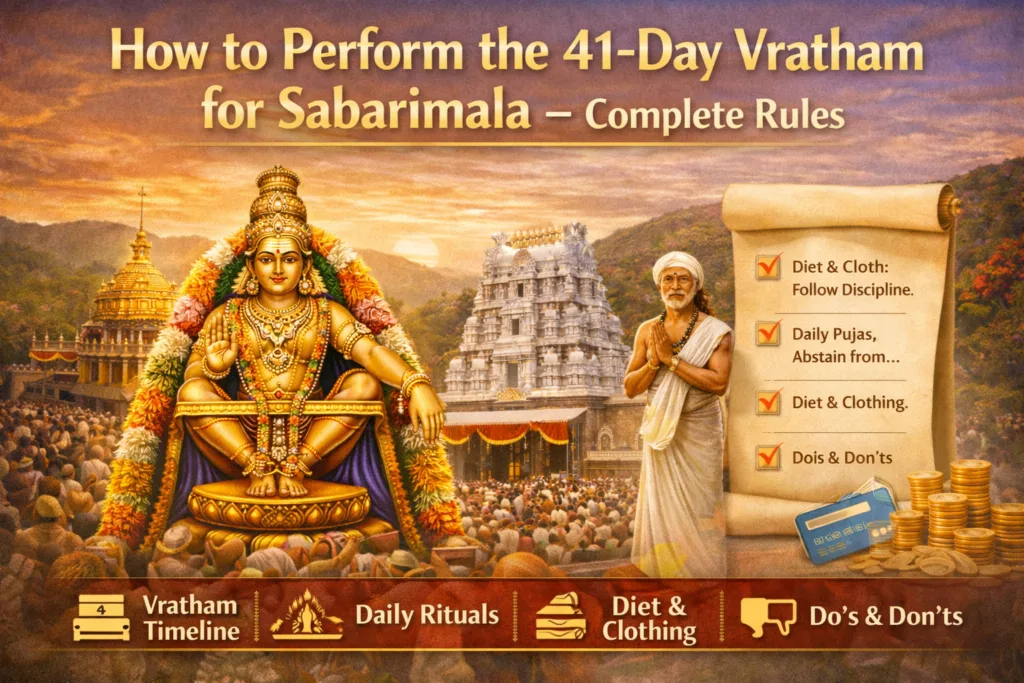
🙏 Introduction: The 41-Day Transformation Before the Sacred Trek
The Sabarimala pilgrimage is often described as one of the most demanding and most spiritually rewarding journeys a Hindu devotee can undertake. But the pilgrimage itself — the trek through the dense forests of the Western Ghats, the climb up the Pathinettam Padi (18 sacred steps), and the darshan of Lord Ayyappa — is only the culminating event of a much longer, deeper journey.
That journey begins 41 days before you set foot on the sacred hill.
The 41-Day Vratham (also written as Vritham or Deeksha) is a period of rigorous spiritual preparation observed by every sincere devotee of Lord Ayyappa before undertaking the Sabarimala pilgrimage. It is not merely a set of rules to follow — it is a complete transformation of lifestyle, thought, speech, and action. For 41 days, the devotee lives as a renunciant — as a Swami — surrendering ego, comfort, and worldly pleasures in devotion to Lord Ayyappa.
The idea behind the 41-day Vrutham is to develop discipline and healthy practices and make it a habit. It is all about good habit formation through sustained efforts achieved through a combination of self-control and prayers.
This guide is the most complete, accurate, and practically detailed resource on the Sabarimala 41-Day Vratham available online — covering every ritual, rule, dietary guideline, daily practice, common doubt, and spiritual insight you need to observe this sacred Deeksha correctly and sincerely.
Swamiye Saranam Ayyappa! 🙏
🌟 What Is the Sabarimala Vratham? The Spiritual Foundation
The Sacred Number 41
The 41-day period is considered crucial for purifying the mind and body, preparing the devotee to have a direct spiritual connection with Lord Ayyappa. The number 41 is not arbitrary — the 41-day period corresponds to a full lunar cycle used in yogic traditions for conditioning the mind.
In the Sabarimala tradition, 41 days represents one complete Mandalam — a sacred cycle believed to be sufficient time for a sincere practitioner to genuinely transform their body chemistry, mental patterns, and spiritual receptivity. Ancient Hindu wisdom teaches that periodic fasts or vrithams purify the human mind and body, and by adhering to an austere way of life and observing tapas in body, mind, and speech, man transcends his earthly limitations.
Who Is Required to Observe the Vratham?
The Vratham is mandatory for every male devotee undertaking the Sabarimala pilgrimage — whether it is their first time or their fiftieth. A pilgrim who makes their first Sabarimala pilgrimage is called a “Kanni Ayyappan” and those who have made several pilgrimages are called “Palamakkars.”
Both Kanni Ayyappans (first-timers) and Palamakkars must observe the 41-day Vratham. However, Kanni Ayyappans are held to a particularly strict standard, and they must be guided at every step by an experienced Guru Swami.
Girls under the age of twelve who have not reached puberty and older women who have reached menopause can also undertake the Sabarimala pilgrimage. For eligible women, the same Vratham rules apply with equal rigour.
The Title “Swami” — What It Means
From the moment the Maala (sacred bead necklace) is worn, the devotee ceases to be referred to by their regular name. They become a Swami — one who has surrendered to the Divine will. Those undertaking this vratham receive the respectful title of “Swami,” acknowledging their temporary renunciation of material pleasures whilst maintaining their worldly duties.
Address all men as “Ayyappa or Swami” and ladies and girls, including your wife, as “Maligapuram” and boys as “Manikanta.” The main principle of Ayyappa Deeksha is that all religions and castes are to be treated as one. Anyone — whether they are Christians, Muslims, or of any other religion — having faith in Ayyappa can worship him.
📅 When Does the Sabarimala Vratham Begin?
The Traditional Start Date
The 41-day fast usually begins on the first day of the Malayalam month of Vrischikam in mid-November. This traditionally aligns with the commencement of the Mandala Kalam — the most sacred pilgrimage season at Sabarimala — which itself runs for 41 days, mirroring the Vratham period.
There is no need to look for an auspicious day or week to begin with the fast. However, devotees consider wearing the Mala on a Saturday or on the day of Uthram — the astral sign and birth star of Sree Ayyappan — to be particularly auspicious.
Can You Begin on Any Day?
Yes. While the traditional start date is the first of Vrischikam, devotees planning to visit Sabarimala during monthly poojas, the Vishu season, or Makaravilakku can begin their 41-day Vratham exactly 41 days before their planned date of departure for the pilgrimage. The key rule is simple: the 41 days of fasting must be completed before you prepare the Irumudi Kettu, so technically you will be climbing the Pathinettam Padi on the 42nd day or later from the day you start your Vratham.
Choosing an Auspicious Start Day
| Most Auspicious Days to Begin | Significance |
|---|---|
| Saturday | Day associated with Saturn (discipline, detachment) |
| Day of Uthram Star | Birth star of Lord Ayyappa — the most auspicious |
| Ekadasi (11th day of lunar fortnight) | Sacred fasting day in Vaishnavite tradition |
| 1st day of Vrischikam (mid-November) | Traditional Mandala Kalam commencement |
🪬 STEP 1: Pre-Vratham Preparation — The Three Days Before Maala Dharana
Before the sacred Maala (bead necklace) is worn and the Vratham formally begins, devotees must observe a three-day purification period, abstaining from meat, alcohol, and negative habits that cloud spiritual clarity.
During these three preparatory days:
- ✅ Shift to a fully vegetarian, sattvic diet
- ✅ Stop consuming alcohol, tobacco, betel, and all intoxicants
- ✅ Observe mental and physical celibacy
- ✅ Bathe twice daily — before sunrise and after sunset
- ✅ Visit your family deity temple and seek blessings
- ✅ Seek permission from parents and your Guru Swami to commence the Deeksha
The devotee embarks on the 41-day Vritham after gaining permission from his parents and Guru. An auspicious day is fixed for the commencement of the Vritham, and on the eve of the said date, he offers poojas to the family deity and makes a holy knot with yellow cloth containing 1.25 currency units, presenting it to the family deity — thereby gaining approval to begin.
🪬 STEP 2: Maala Dharana — The Sacred Bead Ceremony
What Is Maala Dharana?
Maala Dharana (or Malayideel) is the formal commencement ceremony of the Vratham — the ritual act of wearing the sacred Ayyappa bead necklace. Wearing the Mala denotes the onset of the Vrutham. The devotee may wear a bead chain with the locket of Sree Ayyappan. Once the chain is worn, the devotee has to lead a life free of worldly pleasures.
The Maala — Types and Significance
The believers must wear a Tulasimani or Rudraksham sequence that has 108 or 54 beads in them along with an Ayyappan portrait.
| Maala Type | Material | Bead Count | Notes |
|---|---|---|---|
| Rudraksha Maala | Rudraksha seeds | 108 or 54 beads | Most traditional and widely used |
| Tulsi Maala | Tulsi (holy basil) wood beads | 108 or 54 beads | Considered highly sattvic |
| Both are equally valid | — | — | Choice is the devotee’s |
Who Should Give the Maala?
Religious practices mandate that the Mala should be accepted after prayers from a temple priest or a Guru Swami — a person who has completed 18 Sabarimala pilgrimages.
The Mala should be worn through the Guruswamy with whom the devotee intends to perform the Yatra. If the Guruswamy cannot be contacted, the wearing of the Mala can be done through one’s mother or father or at any temple Sannidhanam.
Guru Dakshina
As soon as this tradition of wearing Tulasimani or Rudhratsha sequence is over, the devotees must give Guru Dakshina as much as they can and get the blessings of the Guru. This offering is a token of gratitude to the Guru Swami who takes on the responsibility of guiding the Kanni Ayyappan through this sacred journey.
What Happens During Maala Dharana?
- The Guru Swami (or parent / temple priest) chants sacred Ayyappa mantras
- The Maala is placed around the devotee’s neck with prayers
- Vibhuti (sacred ash) is applied to the forehead
- The Saranam chant — “Swamiye Saranam Ayyappa” — is recited
- The Guru Swami blesses the new Swami and the 41-day journey begins
📋 STEP 3: The Complete Rules of the 41-Day Vratham
From the moment the Maala is worn until the devotee returns home after darshan and removes the Maala, the following rules govern every aspect of daily life.
🚿 Personal Hygiene & Physical Discipline
Taking bath in the pre-dawn hours, regular application of vibhooti, sandalwood paste followed by meditation and singing songs about Lord Ayyappan become part of the Swami’s daily routine for 41 days.
| Practice | Rule |
|---|---|
| Bathing | Twice daily — before sunrise (pre-dawn) and after sunset. Cold water preferred. |
| Vibhuti (Sacred Ash) | Apply to forehead after every bath and prayer session |
| Sandalwood Paste | Apply to forehead daily as part of morning worship |
| Oil | The Ayyappa swami does not oil his hair or body |
| Hair / Beard / Nails | Cutting hair, shaving off facial hair, and cutting nails are forbidden throughout the Vratham period |
| Footwear | No footwear is to be used to protect the feet — walking barefoot is part of the austerity |
| Bed | The Swami does not sleep on a bed — sleeping on the floor on a mat is the prescribed practice |
🥗 Diet Rules — Sattvic Food Only
During the Vratham, devotees follow a simple vegetarian diet, abstaining from alcohol, tobacco, and non-vegetarian food, and practising celibacy.
Permitted (Sattvic) Foods:
- ✅ Rice, wheat, ragi, and other grains
- ✅ All fresh vegetables and leafy greens (avoiding pungent ones — see below)
- ✅ Fruits of all kinds
- ✅ Milk, curd, butter, ghee (unprocessed dairy)
- ✅ Coconut in all forms
- ✅ Lentils and pulses (prepared simply, without heavy spices)
- ✅ Jaggery, honey, dry ginger (used in Neivedyam preparation)
- ✅ Nuts and dry fruits
Strictly Prohibited (Tamasic / Rajasic) Foods:
- ❌ All non-vegetarian food — meat, fish, eggs in any form
- ❌ Alcohol, liquor, wine, beer in any form
- ❌ Tobacco — smoking, chewing, or any form
- ❌ Betel leaves, betel nut (pan, supari)
- ❌ Drugs and narcotics of any kind
- ❌ Onion and garlic (considered rajasic — stimulating; avoided in strict Deeksha)
- ❌ Heavily spiced, fried, or processed foods
- ❌ Stale food — all food should be freshly prepared
🌿 The Principle Behind Sattvic Diet: The Sabarimala tradition teaches that what we eat directly influences our thoughts. A sattvic diet — light, fresh, natural, and free of stimulants — calms the mind, reduces ego, and makes the practitioner more receptive to divine energy. Consuming tamasic food generates inertia and passion — both obstacles on the spiritual path.
🧘 Spiritual Practices — Daily Discipline
From the day of Maala Dharana and commencement of the Vratham, the devotee should take bath twice every day — in the early morning and after sunset — and perform a small pooja at both times. They should also chant Saranams before closing the pooja.
Daily Mandatory Practices:
| Practice | Details |
|---|---|
| Morning Pooja | Light a lamp at the home shrine, offer flowers, recite Ayyappa Sahasranamam or Ashtottaram |
| Evening Pooja | Lighting of lamp, incense, and Saranam chanting after sunset bath |
| Saranam Chanting | Chant “Swamiye Saranam Ayyappa” a minimum of 108 times daily |
| Ayyappa Ashtottaram | Recite the 108 names of Lord Ayyappa daily |
| Visiting Temple | Visit local temples daily throughout the 41-day period |
| Bhajans | Sing devotional songs of Lord Ayyappa — individually or in group sessions |
| Meditation | Spend time in silent meditation, fixing the mind on Lord Ayyappa |
| Tulsi Leaf | The Ayyappa Swami always carries a Tulsi leaf to ward off evil and temptations |
🧍 Behavioural & Social Rules
These rules govern how the Swami interacts with the world during the Deeksha period. They are as important as the physical austerities:
Never get angry under any circumstances. Do not tell lies. Do not hurt others’ feelings either by word or action. Do not take part in death ceremonies. After the Maala Dharana, during the Vratham period, if any close relative passes away, adhere to family traditions and as far as possible avoid performing the Yatra this time.
| Behaviour | Rule |
|---|---|
| Anger | Absolutely forbidden — maintain calm and equanimity at all times |
| Speech | No lies; no harsh words; no gossip; no negative speech |
| Addressing Others | All male adults: “Ayyappa” or “Swami”; Women: “Maligapuram”; Boys: “Manikanta” |
| Entertainment | Avoid movies, clubs, parties, and any entertainment that disturbs mental peace |
| Social Gatherings | Avoid celebratory events (weddings, parties) unless unavoidable |
| Death Ceremonies | Do not participate in funeral/death-related rituals during Deeksha |
| Conflict | Do not engage in arguments, disputes, or confrontational behaviour |
| Humility | See all other Ayyappa Swamis as manifestations of Lord Ayyappa himself |
🛌 Lifestyle Discipline
| Lifestyle Aspect | Rule During Deeksha |
|---|---|
| Sleep | Sleep on the floor on a mat — not on a raised bed |
| Celibacy (Brahmacharya) | Should be observed very strictly during the Vratham period till the reaching of home after Darshan and Abhishekam at Sabarimala — complete celibacy in thought, word, and action |
| Footwear | Walk barefoot as much as possible; no footwear during prayers |
| Oil Bath | No oil application to hair or body during this period |
| Clothing | Black is the recommended colour for clothes during the Vrutham period as the colour denotes detachment from material things; blue or saffron are also permitted |
| Simplicity | Live simply — avoid luxuries, excessive spending, and worldly indulgences |
| Work | You may continue your job and family responsibilities; Deeksha does not require abandoning the world |
| Quietness | When somebody undertakes the 41-day fast, they must go about it quietly without much ado so as not to cause any inconvenience to the family |
🚫 Complete Prohibitions During Vratham
The following are absolutely forbidden from Maala Dharana until the Maala is removed after returning from Sabarimala:
- ❌ Non-vegetarian food (meat, fish, eggs) in any form
- ❌ Alcohol and all intoxicating substances
- ❌ Tobacco — smoking, chewing tobacco, snuff
- ❌ Betel leaves and pan
- ❌ Cutting or trimming hair, beard, or nails
- ❌ Oil bath or applying oil to body/hair
- ❌ Sleeping on a raised bed (cot/mattress)
- ❌ Wearing footwear during prayers and as far as possible throughout
- ❌ Sexual activity (complete celibacy is mandatory)
- ❌ Lying, using harsh words, or hurting others
- ❌ Anger and agitation
- ❌ Attending or participating in death/mourning ceremonies
- ❌ Entering a home where a birth or death has occurred within the customary period
- ❌ Eating at restaurants or hotels (home-cooked sattvic food is preferred)
📦 STEP 4: Kettunirakkal — Preparing the Sacred Irumudi Kettu
The Irumudi Kettu (meaning “two bundles” or “two knots”) is the pilgrim’s essential ritual bag — and it is the most distinctive symbol of the Sabarimala devotee. Only those who observe the 41-day Vritham are allowed to carry it, and without the Irumudi, the devotee cannot climb the Pathinettam Padi at the Sannidhanam.
The Irumudi functions as the pilgrim’s spiritual passport, required for climbing the holy Pathinettam Padi (18 steps) at Sabarimala Temple. This profound ritual carries deep philosophical significance rooted in Advaita Vedanta — the act of tying the Irumudi represents non-duality, where the devotee (Bhakta) and the worshipped deity merge into a single entity, embodying the Upanishadic truth “Tat Tvam Asi” (Thou Art That).
Structure of the Irumudi Kettu
The Irumudi Kettu is divided into two compartments (pouches) tied together:
🥥 Front Pouch (Munmudi) — For Lord Ayyappa
The Munmudi (front pouch) dedicates itself entirely to Lord Ayyappa, containing offerings and puja items representing the devotee’s virtuous acts accumulated over the Vratham period.
| Item | Purpose |
|---|---|
| Coconut filled with ghee | The most sacred offering — ghee-filled coconut is broken at the 18 steps and the ghee is used for Abhishekam |
| Vibhuti (Sacred Ash) | For application at Sannidhanam |
| Kumkumam (Vermilion) | For offerings and tilak |
| Chandanam (Sandalwood) | For anointing |
| Flowers and Garlands | For offering to the deity |
| Panchamrutam ingredients | Jaggery, cashewnuts, raisins, cardamom, honey and dates for making Panchamrutam as Neivedyam; with jaggery, dry ginger and cardamom, another Neivedyam termed Panagam is also prepared |
| Coins (Dakshina) | For offering at the temple |
| Tulsi, Manjal (turmeric) | For ritual use |
🎒 Back Pouch (Pinmudi) — For the Pilgrim
The Pinmudi contains articles for the pilgrim’s personal use — items for use from the day of commencement of the journey after Kettunira till return. The second bag contains some snacks and other ingredients such as rice and pulses for food prepared during the journey.
Kettunirakkal — The Irumudi Packing Ceremony
The Kettunirakkal (or Kettunira) is the auspicious ritual of packing the Irumudi Kettu. This is not done casually — it is a sacred ceremony:
- The ceremony is performed at the devotee’s home, the Guru Swami’s home, or at the local Ayyappa temple
- It is the Guruswami who prepares the Irumudi Kettu and places it on the head of the devotee
- Prayers are offered, Saranams are chanted, and the Irumudi is blessed
- Once the Irumudi is placed on the head, the formal Sabarimala Yatra has begun
- The Irumudi Kattu Pooja should be performed at the devotee’s house, the Guru’s house, or in the temple
🔔 Important: The Irumudi must be carried on the head — not in the hands, not on the shoulder, not in a bag. It is considered the most sacred object the pilgrim carries, and it rests on the head as a symbol of surrendering the entire self (including the crown — seat of the ego) to Lord Ayyappa.
🔥 STEP 5: Aazhi Pooja (Fire Ritual) & Pre-Departure Prayers
Before departing for Sabarimala, most groups of pilgrims perform the Aazhi Pooja — a sacred fire ritual.
Rice flakes, parched rice and pieces of coconut are thrown regularly into the raging fire. The flames are believed to be Lord Ayyappan himself and the articles hurled into the fire represent worldly desires which are annihilated by Lord Ayyappan, who is the embodiment of true wisdom. Sometimes, the Ayyappas, ecstatic and oblivious to their surroundings, walk on the Aazhi out of devotional fervour. Soon afterwards, poojas are performed and camphor burnt. Burning of camphor leaves no traces behind — it therefore connotes total destruction of the meaningless longings of the aspirant.
Additionally:
- A few days before the departure, a “Kanni Pooja” should be performed by first-time pilgrims (Kanni Ayyappans). Bhajans and collective worship should be conducted in an elaborate manner and offerings made to Ayyappan devotees and others.
- The entire group chants Swamiye Saranam Ayyappa together
- The journey commences with the pilgrim carrying the Irumudi on the head
🏔️ STEP 6: Special Rules for Kanni Ayyappan (First-Time Pilgrims)
The Kanni Ayyappan — a devotee making their maiden Sabarimala pilgrimage — is held to the highest standards of conduct and receives special guidance. The word “Kanni” means “virgin” in Malayalam, denoting the pure, untouched quality of one undertaking this sacred journey for the first time.
Mandatory Rules for Kanni Ayyappans
| Rule | Detail |
|---|---|
| Guru Swami | A Kanni Ayyappan must be accompanied by a Guru Swami — an experienced devotee who has completed at least 18 Sabarimala pilgrimages and who takes spiritual responsibility for the new pilgrim |
| Guru Swami Authority | The Kanni Ayyappan must follow the Guru Swami’s instructions at every step of the pilgrimage |
| Extra Strictness | Kanni Ayyappans are expected to observe the Vratham rules with even greater strictness than experienced pilgrims |
| Kanni Pooja | A special prayer ceremony must be performed at the home/temple before departure |
| First Trek | The Kanni Ayyappan must complete the traditional trek route via Erumeli if possible — the traditional route begins there |
| First Climb | The first climb of the 18 sacred steps (Pathinettam Padi) is accompanied by special prayers guided by the Guru Swami |
| Coconut Sapling | The Ayyappa Swami who ascends the Pathinettam Padi for the 18th time plants a coconut sapling on Sabarimala — on their first visit, Kanni Ayyappans offer their coconut ghee with special intent |
🛕 STEP 7: At Sannidhanam — The Culmination of the Vratham
After the trek from Pamba, the pilgrim arrives at the Sannidhanam — the temple complex on the hilltop. The Irumudi, carried throughout the journey on the head, is now brought to the 18 sacred steps.
The Pathinettam Padi (18 Sacred Steps)
The 18 steps of Sabarimala are among the most sacred in all of Hindu pilgrimage. Only those who complete the forty-one-day Vratham with sincerity earn permission to carry the blessed Irumudi bundle and ascend the Pathinettam Padi.
Each of the 18 steps has a distinct symbolic significance in the Ayyappa tradition:
| Steps | Symbolism |
|---|---|
| Steps 1–5 | The five human senses (Pancha Indriyas) to be transcended |
| Steps 6–13 | The eight Ashtaragas (passions — desire, anger, greed, attachment, pride, jealousy, ego, delusion) to be conquered |
| Steps 14–17 | The four antahkaranas (inner instruments — mind, intellect, ego, consciousness) to be purified |
| Step 18 | The final surrender — complete union with Lord Ayyappa |
Before climbing, the ghee-filled coconut is offered and broken at the base of the steps. The ghee flows out — symbolising the dissolution of the ego. The pilgrim then climbs the 18 steps, Irumudi on head, chanting Swamiye Saranam Ayyappa with each step.
🧧 STEP 8: Maala Removal — Ending the Deeksha
The Ayyappa Deeksha officially ends only after the pilgrim has:
- ✅ Completed the Sabarimala darshan and Abhishekam
- ✅ Returned home safely
- ✅ Had the Maala removed in the presence of the Guru Swami or mother
Deeksha ends with Maala removal before a Guru Swami or mother after returning from Sabarimala.
Brahmacharya should be observed very strictly during the Vratham period till the reaching of their home after the Darshan and Abhishekam at Sabarimala. This means the rules of the Deeksha remain in full force even on the return journey — until the Maala is ceremonially removed at home.
The Maala removal is accompanied by:
- Prayer of gratitude to Lord Ayyappa
- Chanting of Saranams
- Offering of flowers and incense
- The pilgrim then prostrates before the Guru Swami and seeks blessings
📋 Quick-Reference Rules Summary — The Sabarimala Vratham Cheat Sheet
✅ DO During the 41-Day Vratham
- Wear the Ayyappa Maala at all times (day and night)
- Bathe twice daily — pre-dawn and after sunset
- Apply vibhuti and sandalwood paste after every bath
- Follow a strict sattvic vegetarian diet
- Visit your local temple daily
- Chant Swamiye Saranam Ayyappa minimum 108 times daily
- Recite Ayyappa Ashtottaram (108 names) daily
- Sing bhajans and devotional songs
- Sleep on the floor on a mat
- Walk barefoot whenever possible
- Carry a Tulsi leaf
- Wear black, blue, or saffron clothing
- Address all men as “Swami” or “Ayyappa”
- Address all women as “Maligapuram”
- Treat all people as equal — across all castes and religions
- Observe complete celibacy in thought, word, and deed
- Maintain peace, patience, and compassion at all times
- Perform Kanni Pooja and Aazhi Pooja before departure
❌ DON’T During the 41-Day Vratham
- Do NOT eat meat, fish, or eggs in any form
- Do NOT consume alcohol, drugs, or tobacco in any form
- Do NOT chew betel or pan
- Do NOT cut hair, beard, or nails
- Do NOT apply oil to hair or body
- Do NOT sleep on a raised bed
- Do NOT lie, gossip, or speak harshly
- Do NOT lose your temper
- Do NOT participate in death or mourning ceremonies
- Do NOT enter homes with recent birth or death (customary period)
- Do NOT engage in sexual activity
- Do NOT eat at restaurants unless absolutely unavoidable
- Do NOT eat onion or garlic (strict Deeksha observers)
- Do NOT travel without the Irumudi Kettu once the journey begins
- Do NOT climb the 18 steps without the Irumudi
❓ Sabarimala 41-Day Vratham — 15 FAQs
Q1. Is the 41-day Vratham mandatory for all Sabarimala pilgrims? A. Yes. The 41-day Vratham is a mandatory spiritual observance for pilgrims undertaking the Sabarimala pilgrimage. Every devotee — first-timer or veteran — must observe it.
Q2. Can I start the Vratham on any day? A. There is no need to look for an auspicious day or week to begin with the fast. However, Saturday or the day of Uthram star are considered most auspicious for beginning.
Q3. Who is a Guru Swami and why is one needed? A. A Guru Swami is a person who has completed 18 Sabarimala pilgrimages. They guide, bless, and take spiritual responsibility for the devotee — particularly critical for Kanni Ayyappans (first-timers).
Q4. What is the Irumudi Kettu and is it mandatory? A. The Irumudi Kettu is the pilgrim’s essential travel bag. Only those who observe the 41-day Vritham are allowed to carry it and without the Irumudi, the devotee cannot climb the Pathinettam Padi. It is absolutely mandatory.
Q5. Can Muslims and Christians observe Ayyappa Deeksha? A. The main principle of Ayyappa Deeksha is that all religions and castes are to be treated as one. Anybody — whether they are Christians, Muslims or of another religion — having faith in Ayyappa can worship him.
Q6. Can women observe the Vratham and visit Sabarimala? A. Girls under the age of twelve who have not reached puberty and older women who have reached menopause can undertake the Sabarimala pilgrimage. Eligible women must observe the same 41-day Vratham rules as men.
Q7. Can I continue working during the 41-day Vratham? A. Yes. When somebody undertakes the 41-day fast, they must go about it quietly without much ado so as not to cause any inconvenience to the family. The Deeksha is observed alongside normal family and work life.
Q8. What happens if a family member dies during my Deeksha? A. After the Maala Dharana, if any close relative passes away during the Vratham period, adhere to your family traditions and as far as possible avoid performing the Yatra this time.
Q9. Can I eat onion and garlic during the Vratham? A. While onion and garlic are technically vegetarian, strict Deeksha observers avoid them as they are considered rajasic (passion-stimulating) foods that disturb mental peace. Most traditional practitioners avoid them entirely.
Q10. What is the significance of the number 41? A. The 41-day period corresponds to a full lunar cycle used in yogic traditions for conditioning the mind. It is considered the minimum period needed to genuinely transform mental and physical patterns.
Q11. Can I remove the Maala during the 41 days? A. No. The Maala must be worn continuously from Maala Dharana until the formal removal ceremony at home after returning from Sabarimala. Removing it prematurely breaks the Deeksha.
Q12. What does “Swamiye Saranam Ayyappa” mean? A. The chant translates to “Lord Ayyappa, I surrender myself to you.” It reflects humility, faith, and total surrender — the essential values of the Yatra.
Q13. What is Kanni Pooja? A. A few days before the departure of the pilgrimage, a Kanni Pooja (virgin/first pooja) should be performed. Bhajans and collective worship are conducted in an elaborate manner and offerings made to Ayyappan devotees and others.
Q14. What is the significance of wearing black during the Deeksha? A. Black is the recommended colour for clothes during the Vrutham period as the colour denotes detachment from material things. It is also a practical marker that identifies the devotee as being on Deeksha.
Q15. When does the Deeksha officially end? A. Deeksha ends with Maala removal before a Guru Swami or mother after returning from Sabarimala. All Vratham rules apply until this moment — including on the return journey home.
🌟 The Deeper Meaning: Why the Vratham Transforms You
The 41-Day Vratham is not a set of restrictions imposed from outside. It is an invitation to discover what you are when you remove everything you are not.
When you stop eating stimulating food, when you stop reacting in anger, when you walk barefoot, when you sleep on the floor, when you address every person as Swami — you strip away, layer by layer, the accumulated comfort, ego, and habit that separates you from your deepest self.
The austerity practised during the pilgrimage is meant to strip away ego and attachments. Pilgrims eat simple food, avoid luxury, and follow strict behavioural codes. This shared discipline creates a powerful sense of unity and collective devotion.
By the time the 41st day arrives and you stand at the base of the Pathinettam Padi with your Irumudi on your head, chanting Swamiye Saranam Ayyappa — you are not the same person who wore the Maala 41 days ago. You have been changed. And it is that changed, purified, surrendered self that Lord Ayyappa receives at the top of the sacred hill.
This transformative practice purifies the mind and body, enabling devotees to merge their individual soul (Jeevatma) with the Supreme Consciousness (Paramatma).
Swamiye Saranam Ayyappa! 🙏